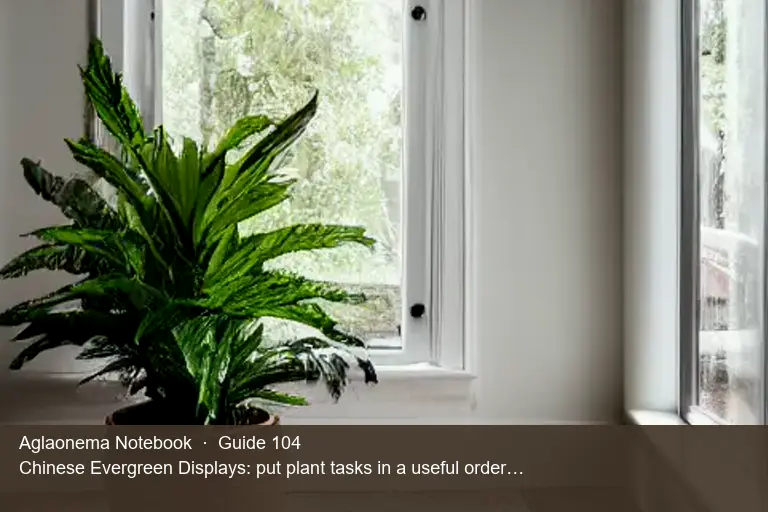
Chinese Evergreen Displays: put plant tasks in a useful order — preparation guide for a compact growing area; setup with paper records
**Chinese Evergreen Displays: A Practical Guide for Efficient Planning and Management**
Evergreen displays are a timeless choice for plant display areas, offering a compact yet stylish appearance. Chinese evergreen displays are a great choice for those with limited space, as they are designed to maximize the space available. In this article, we will discuss how to organize Chinese evergreen displays efficiently, focusing on the key steps involved in the preparation and setup process. We will also provide a step-by-step guide on how to use paper records to organize the displays effectively. This article aims to help readers put plant tasks in a useful order, making their evergreen display area more functional and organized.
**Preparation Step: Define the Purpose of the Evergreen Display**
Before you begin your evergreen display, it's essential to determine the purpose of your display. The purpose should be clear and specific to ensure that the display is functional and visually appealing. For a compact growing area, the purpose could be to display plants that have similar needs, such as water requirements, sunlight, and soil type. For example, you might want to display plants that require less water and grow best in a container rather than in the ground.
**Setup Step: Arrange Plants Based on Purpose**
Once you know the purpose of the display, you can start arranging the plants. Arrange the plants according to the purpose of your display. For instance, you might arrange the plants that require less water in the center of the display, and the plants that require more water and sunlight in the outer edges. You can also arrange the plants based on the soil type, with the plants that need more soil in the center of the display, and the plants that need less soil in the outer edges.
**Paper Records: Effective Step-by-Step Guide for Organizing the Evergreen Display**
Organizing the Chinese evergreen display using paper records is an essential step in the evergreen display process. Paper records can be used to keep track of the plants, their needs, and their placement. Here's how to organize the evergreen display using paper records:
- **Label the Paper Records**: Label each paper record with the plant's name, the purpose of the display, and any additional notes about the plant's needs. For example, you might label a record with "Sunlight," "Water," "Sun," "Water," and "Sunlight," and "Water," "Sun," "Water," "Sunlight," and "Water," respectively.
- **Arrange the Plants**: Use the paper records to arrange the plants in the desired order.
- **Keep track of the Plants**: Keep track of the plants by using a separate section for each plant. For example, you might keep a separate section for each plant that requires more soil in the center of the display, and a separate section for each plant that requires less soil in the outer edges.
- **Organize the Plants**: Use the paper records to organize the plants in the desired order. For instance, you might organize the plants that require less water in the center of the display, and the plants that require more water and sunlight in the outer edges.
**Conclusion: Putting Plant Tasks in a Useful Order**
Organizing Chinese evergreen displays using paper records is an essential step in the evergreen display process. By following the steps outlined above, you can organize the display in a way that maximizes the use of space and makes the display visually appealing. By following the steps, you can ensure that your Chinese evergreen display is efficient and effective in the long term. So, the next time you plan your Chinese evergreen display, make sure to use paper records to organize the plants and make the display more functional and organized.